
Why Mortise Locks Are Common in West Palm Beach Condos
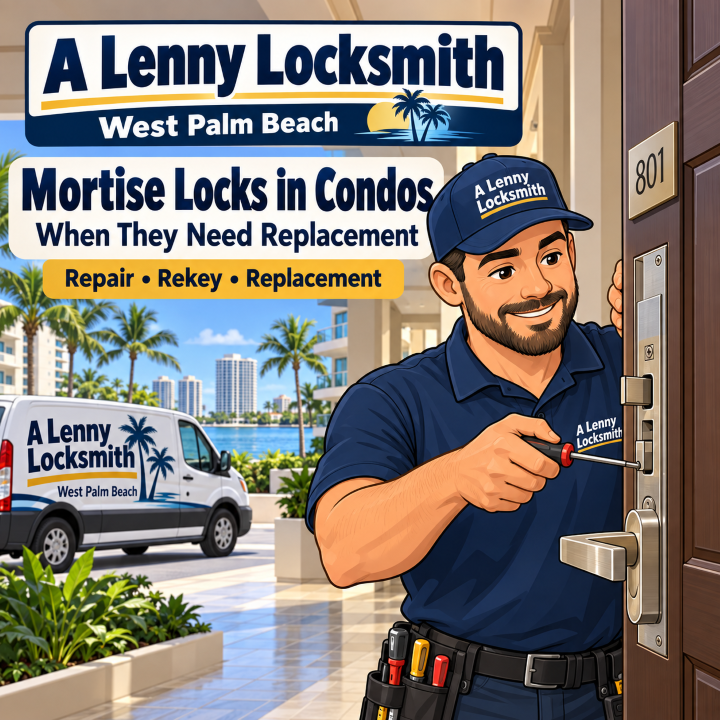
Why Mortise Locks Are Common in West Palm Beach Condos—and When They Need Replacement
If you live in a condo in West Palm Beach, there is a good chance your front door uses a mortise lock. These locks are very common in condominium buildings, especially in older high-rise and mid-rise properties throughout South Florida.
Mortise locks are strong, durable, and designed for doors that get used frequently. But like any mechanical lock, they eventually wear out. When they do, replacing them is not always as simple as installing a standard residential deadbolt or doorknob.
At A Lenny Locksmith West Palm Beach, we regularly work on condo doors equipped with mortise lock systems. Understanding how these locks work can help you recognize problems before you are completely locked out.
What Is a Mortise Lock?
A mortise lock is installed inside a pocket, or mortise, that has been cut into the edge of the door.
Unlike a standard residential lock, where most of the hardware sits on the surface of the door, the main mortise lock body is hidden inside the door itself.
The lock body may contain several components, including the latch, deadbolt, locking mechanism, spindle, and cylinder.
Because everything is built into one heavy-duty lock body, mortise locks are commonly used on apartment buildings, condominiums, commercial doors, hotels, and other properties where security and durability are important.
Why Are Mortise Locks So Common in West Palm Beach Condos?
Many condominium buildings in West Palm Beach were constructed with heavy wood or metal entry doors.
Mortise locks work extremely well with these types of doors.
They are also designed to handle repeated daily use. In a condo building, a resident may open and close the same door several times every day for decades. A properly installed mortise lock is built to withstand that kind of use.
Another advantage is security.
A quality mortise lock usually has a much larger internal lock body than a standard tubular lock. The locking components are installed deep inside the door, making the system strong when properly maintained.
Mortise locks can also be configured with different types of cylinders and key systems, which makes them useful in buildings with master-key systems or other controlled-access arrangements.
Signs Your Mortise Lock May Be Wearing Out
Mortise locks can last for many years, but internal parts eventually wear.
One of the first warning signs is a handle or lever that starts to feel loose.
You may also notice that the latch does not retract smoothly when you turn the handle.
Other common symptoms include a key becoming difficult to turn, a deadbolt that does not extend completely, a door that must be pushed or pulled before the lock works, or a handle that does not return to its normal position.
These problems should not be ignored.
A small internal spring or worn component can eventually fail completely, leaving the door unable to open or lock
Sometimes the Lock Is Not the Real Problem
Before replacing a mortise lock, it is important to check the door itself.
South Florida humidity, building movement, and years of repeated use can cause condo doors to shift slightly.
If the door is no longer aligned correctly with the frame, the latch or deadbolt may rub against the strike plate.
This can make a perfectly good mortise lock feel defective.
A locksmith should inspect the door alignment, hinges, strike plate, cylinder, and internal lock body before deciding which parts actually need replacement.
Sometimes a simple adjustment can solve the problem.
Can a Mortise Lock Be Repaired?
Many mortise locks can be repaired if the main lock body is still in good condition.
Depending on the problem, a locksmith may be able to replace the cylinder, spindle, lever, spring, or another internal component.
However, if the lock body is badly worn, damaged, or obsolete, replacing the complete mortise lock may be the better option.
This is especially important with older condo locks where replacement parts may no longer be readily available.
Because mortise locks come in many different sizes and configurations, the replacement lock usually needs to match the existing door preparation very closely.
Installing the wrong lock can require unnecessary cutting or modification to the door.
Call a West Palm Beach Locksmith Before the Lock Completely Fails
If your condo lock is becoming harder to operate, do not wait until the door will no longer open.
Early repair is often easier than dealing with a completely failed mortise lock.
A professional locksmith can inspect the lock, determine whether it can be repaired, and recommend a compatible replacement when necessary.
A Lenny Locksmith provides professional locksmith service throughout West Palm Beach and surrounding Palm Beach County areas.
Whether your condo mortise lock is sticking, loose, worn, difficult to turn, or completely broken, having it inspected early can help keep your door secure and prevent an unexpected lockout.